 HumanoidTraining
Factory floor
What is actually running in plants, and what is not
The gap between the keynote and the shift report is wide. Here is the verified part.
The documented deployments
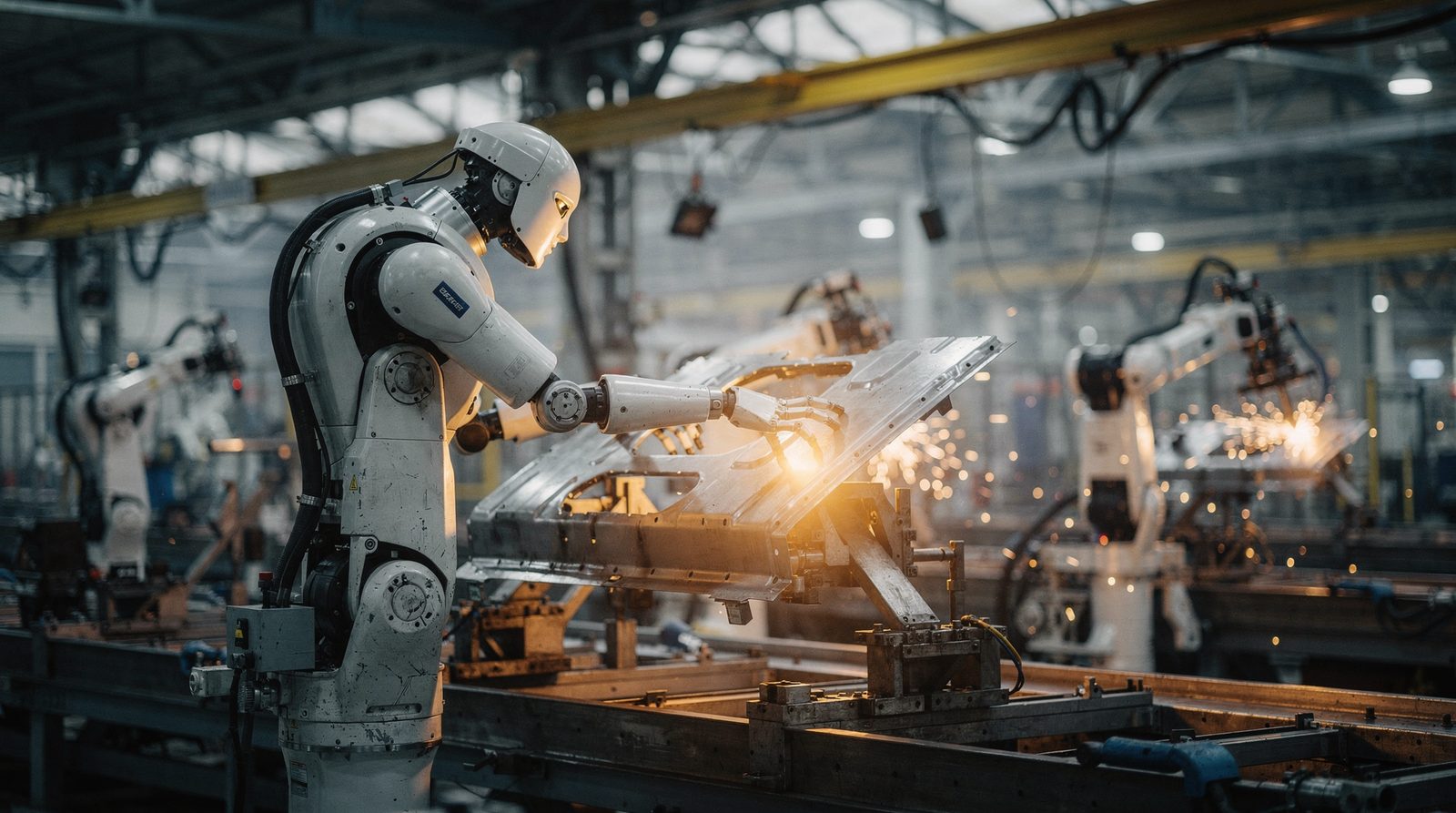
- Figure AI at BMW SpartanburgFigure 02 robots ran for eleven months on the Spartanburg line, contributing to more than 30,000 X3 vehicles by inserting sheet-metal parts for welding in the body shop. Reported figures include over 99% placement accuracy per shift, an 84-second cycle time, 90,000+ parts placed and roughly 1,250 operational hours. This is the strongest verified industrial record in the field. In June 2026 BMW moved to the next-generation Figure 03 at the same plant, this time for production logistics: sorting loose components into sequencing trolleys for the assembly line. A separate European pilot runs at Plant Leipzig.
- Schaeffler and Hexagon’s AEON, in a “Humanoid Gym”The most explicitly training-shaped programme announced so far. Schaeffler has put Hexagon’s AEON humanoid inside a dedicated training hall in Germany and runs it through a three-stage model: train, validate, then deploy. The partners say they are targeting at least 1,000 AEON units. To be fair, they have not said which tasks the robot learns first, and no timeline has been published.
- Agility Robotics’ Digit at Amazon and GXODigit moves totes in logistics facilities. Agility’s RoboFab in Oregon is built for up to 10,000 robots a year. Narrow task, real customers, real invoices.
- Boston Dynamics’ electric Atlas at HyundaiThe redesigned Atlas is being trialled in Hyundai plants, driven by Large Behavior Models trained on demonstrations.
- Tesla Optimus, inside Tesla onlyTesla has never published a production count. On the Q4 2025 earnings call on 28 January 2026, Elon Musk said Optimus was “not in usage in our factories in a material way”, that the program was still in the R&D phase, and that significant production volume was not expected until the end of 2026. That is the honest state: robots present on a floor, collecting data, not yet replacing labour measurably. Headlines claiming 50,000 units or 1,000 robots on production lines do not come from Tesla.
Independent trackers estimate roughly 7,000 to 8,000 commercial humanoids operating worldwide as of mid-2026, the majority of them Unitree units sold to researchers rather than robots on a shift.
What the robots actually do
The 2026 pattern is narrower than the pitch decks. Tote moves. Sheet-metal loading into fixtures. Parts sequencing and kitting. Tasks where the robot uses aisles, carts and fixtures built for people, so the plant does not have to change. Unstructured assembly, anything requiring judgement about a part that is out of spec, comes later.
The safety problem nobody solved yet
An industrial arm is made safe the oldest way there is: cut the power. That is a Stop Category 0, it is certifiable under ISO 13849-1 and EN 60204-1, and it works because an unpowered arm simply stops.
A humanoid cannot do that. Remove power from a machine that is balancing on two legs and it falls over, so the classical safe state is itself the hazard. A 2026 feasibility study gave this a name, the fail-passive gap, and put it plainly: the one certifiable reaction a safety system is built around, contactor-based power removal, is exactly the element a balancing humanoid cannot have.
The standards are moving, but around the edges of this. ISO 10218 was revised in 2025 in two parts, for robots and for applications, and the collaborative force limits that used to live in ISO/TS 15066 were folded into it. ISO 12100 still governs the risk assessment and IEC 61508 the functional safety, where robot safety controllers usually target SIL 2 or SIL 3. A separate draft, ISO/CD 25785-1, is being written specifically for dynamically stable robots, which is the category a walking humanoid falls into.
To be fair, none of this stops the pilots. BMW, Amazon and Hyundai are running robots today under ordinary industrial risk assessments, usually fenced, slowed, or kept away from people.
Why a fab is a harder room
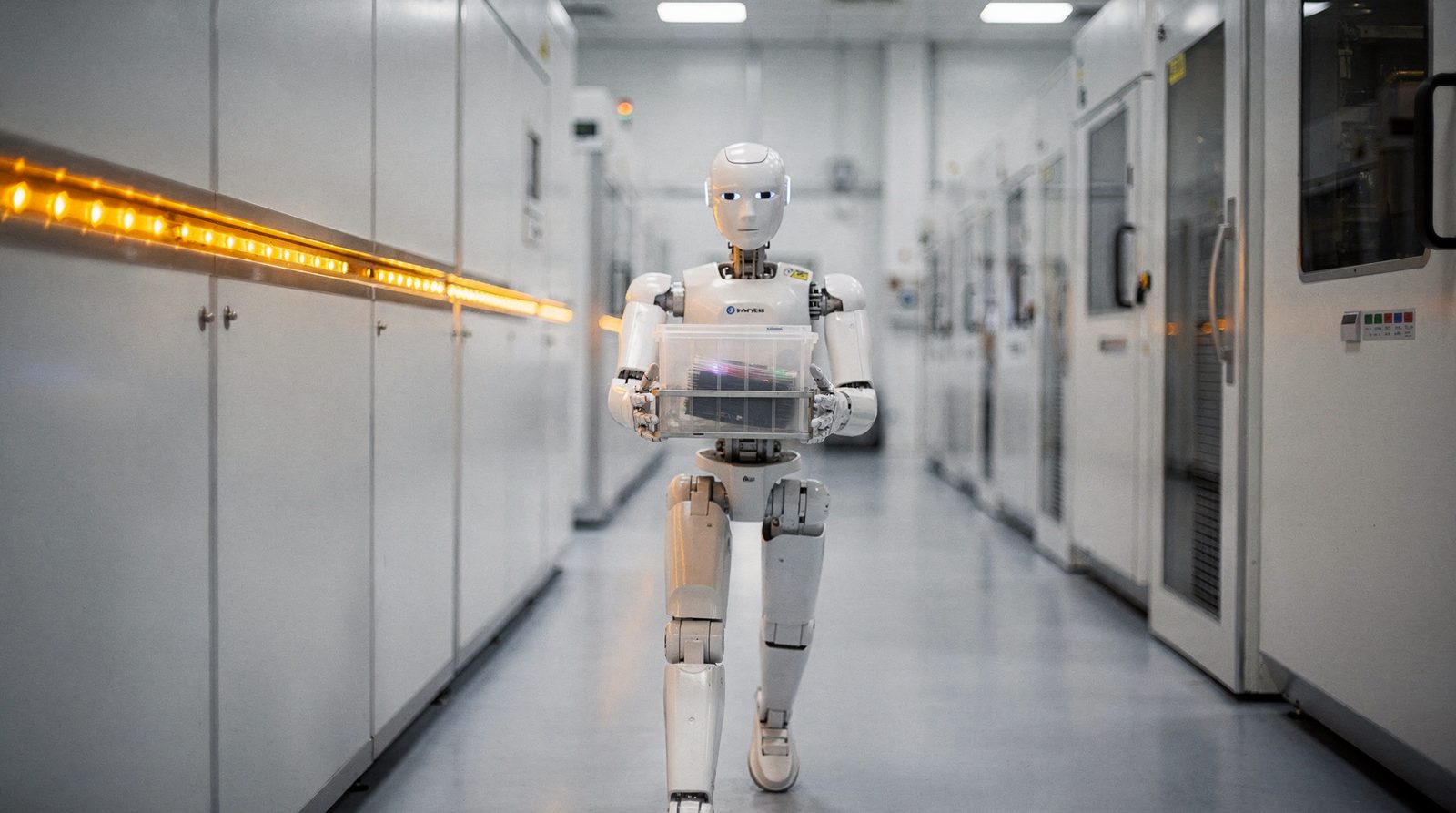
Car plants and warehouses are where humanoids are being proven. A semiconductor fab is the next room, and it is harder for reasons that have nothing to do with the robot’s intelligence.
Cleanliness. A humanoid sheds particles from joints, cables and fabric. A Class 1 cleanroom does not forgive that. Expect sealed, purpose-built variants before anything walks past a lithography tool.
Traceability. Every wafer lot movement in a fab is a transaction in the MES. A robot that moves a FOUP must log it the way an operator or an AMHS vehicle does, or the fab loses the trail. Training the policy is the easy half; integrating it with the execution system is the half that gets missed.
Consequence of error. A dropped tote costs a tote. A dropped FOUP can cost twenty-five wafers of advanced-node product. The training data has to cover the failure cases, and the deployment has to include a human in the loop for a long time.
Where it will start. Sub-fab and support areas: chemical delivery, consumable swaps, maintenance assistance on tools where a human currently gowns up for a five-minute task. The economics are best where the gowning overhead is highest.